
Software design trade-offs
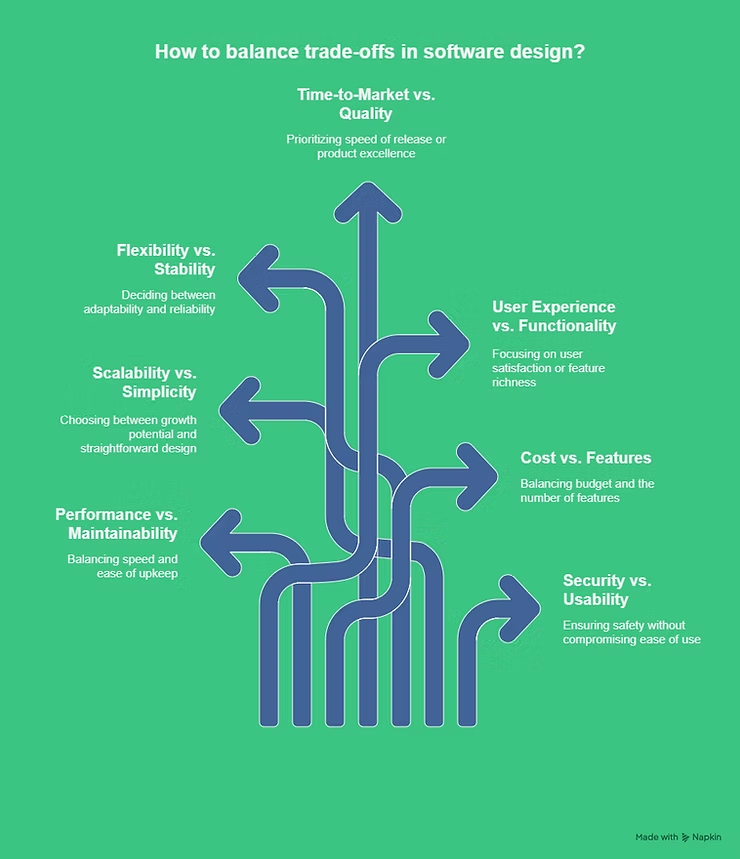
Software design trade-offs Software design refers to the “how” of building your software application and is an important topic to consider and implement according to your specific business use-case. There is no one size fits all and a lot of times not understanding it leads to costly mistakes that take a lot of time and money to recover or even kill a business. Software design trade offs are the decisions made during system architecture or component design that involve balancing competing priorities. Every design choice has benefits and costs, and understanding these trade offs helps teams make informed decisions that align with project goals. Let’s look at an example of a product-based start-up trying to build an MVP. If the goal is to test the idea and see if users will sign-up, then building the initial product with a complex micro-services architecture with distributed caching and infinite scaling is an overkill. MVPs are proof of concepts and are so called because they are built in an environment where time to market is crucial and financial runway is minimal. You can’t use a complex design that ticks all the boxes at this stage as software design requires time and financial resources which are limited. Once the market is validated and the product is funded then it can be enhanced for scale. This is one example of a trade-off that one needs to consider. Build small for MVPs and scale once PMF is validated. When you go full throttle building your application, there are many trade-offs that you’ll have to make. Here are some common ones: Scalability vs Simplicity – Monoliths are easy to build and deploy as there are less moving parts, however they are harder to scale. Microservices on the other hand have an overhead to manage different repositories and deployment pipelines but are easier to scale since they are a bunch of small working components connected together. It’s also easier to scale one particular function that has significant load than other parts of the app. Security vs Usability – Security must be built into the design to prevent any compromised entry into the application, however this also creates friction points for the user and may drive them away from the application. Transaction replays vs re-execution – Event driven applications are able to trigger actions on services based on an incoming message and if the messages are persisted, then they can be replayed if there is a failure or outage on the application. On the contrary, in a monolith all incoming requests have to be recreated or resent from the source if the application was unavailable at the time they came in for execution. Consistency vs Availability – In distributed systems, you often trade consistency (correct data) for availability (system responsiveness) during partitions, so in this case data may not be immediately up to date across nodes. This may be okay for non-critical applications like social media apps but may not work for emergency services or banking services for example where real time updates are required. Generic vs specific solutions – Generic solutions work in many contexts but may be over-engineered. Specific solutions are fast to build but harder to reuse or extend. How to decide Identify the key trade offs relevant to your decision (e.g., consistency vs. availability). List options (e.g., tech stacks, architecture patterns). Score each option across relevant criteria (1–5 scale or qualitative notes). Weigh what’s most important (e.g., prioritize time-to-market for MVPs). Document the decision and trade-offs clearly for future reference. In summary, software design is fundamental and the trade-offs have to be thought through before building an application. There is no right or wrong decision as the application changes over time and the design decisions once made also have to evolve accordingly. The key is to minimize the impact and adopt change early enough before it becomes very invasive. At Tenafor, we help our clients identify trade-offs early in the software design process ensuring solutions are practical and provide maximum value at that specific stage of the business. If you need help in understanding what trade-offs you need to make to build your application, reach out to us for a free consultation at info@tenafor.com and we would be happy to hear you out!
How to Design Extendable Software That Grows With Your Business
How to Design Extendable Software That Grows With Your Business Introduction Ever built a product, only to find out six months later that adding new features feels like hacking spaghetti code? We’ve all been there. As your product scales and customer demands evolve, extendability becomes a crucial factor for survival. The good news? You can design software today that’s ready for tomorrow’s challenges. In this post, I’ll break down how to create software that’s easy to extend without constant rewrites. Why Extendability Matters As businesses grow, so do product requirements. Whether it’s adding new integrations, supporting additional platforms, or expanding features, software that can’t adapt will eventually bottleneck your team. Extendable software: Reduces time-to-market for new features. Lowers long-term technical debt. Improves team productivity and morale. Core Principles of Extendable Software Here are the foundations you should stick to when designing for flexibility: Modularity – Break your system into smaller, self-contained components. Clear Interfaces – Define and document APIs to ensure modules communicate cleanly. Loose Coupling – Minimize dependencies between components. High Cohesion – Keep related logic grouped, and unrelated logic separate. Real-World Example: Plugin System in CMS Let’s look at WordPress. Its plugin system is a textbook example of extendable architecture: Developers can build independent plugins without touching WordPress core. The CMS exposes clear hooks (actions & filters) that plugins can tap into. Businesses can easily extend WordPress to suit e-commerce, blogs, or even LMS needs—without reinventing the wheel. How to Make Your Software Extendable Here’s how you can apply these principles today: Choose the Right Architecture Opt for modular or microservices architectures where appropriate. Implement Design Patterns Use patterns like the Strategy Pattern to make behaviors interchangeable, or the Observer Pattern for event-driven systems. Invest in Documentation Developers should easily understand how to extend the system (clear README files, API docs, and contribution guides). Consider a Plugin/Extension Framework Especially useful for SaaS platforms, marketplaces, or dev tools. Prioritize Test Coverage Unit and integration tests protect your core while allowing safe extensions. Conclusion Extendable software isn’t just a nice-to-have—it’s a competitive advantage. By baking flexibility into your design upfront, you’ll save time, reduce risk, and keep your product agile as new opportunities arise. 👉 Ready to start building software that scales with you? Share your thoughts or questions in the comments!
Future-Proofing Procurement Tech: How HattiOps Scaled Notifications Seamlessly

Future-Proofing Procurement Tech: How HattiOps Scaled Notifications Seamlessly Meet Mr. Shasedaran KKS, the founder of HattiOps, a company on a mission to simplify procurement processes for corporates. With over five years in business, HattiOps has helped streamline sourcing and purchasing across industries. The Problem: Flexible Notifications When we first met Shasedaran and his team, they had a clear vision: to build a digital platform that could manage RFQs and estimates between corporate purchasing heads and vendors. But they had a smart approach—they wanted to build the system in phases, integrating key capabilities one step at a time. One such feature on their roadmap was notifications. At launch, only email notifications were needed. But they knew this would expand: WhatsApp and SMS were in the pipeline. So the challenge was clear: design the system to be flexible enough to support future channels—without rewriting the application every time. The Solution: Event-Driven Notification Service This means the core application doesn’t directly handle how notifications are sent. Instead, it emits events—like “RFQ Created” or “Estimate Approved”—and independent listeners handle what to do next. Initially, we wired up the email notification listener. Later, when the client was ready, we plugged in SMS and WhatsApp listeners—without touching the core logic. The Result: A Scalable, Modular Notification System Because we architected the system with future growth in mind, HattiOps was able to seamlessly add new notification channels as business needs evolved. There was no need to refactor or rework the application. Just plug-and-play. Why This Matters Too often, early design decisions limit future flexibility. But in this case, a future-proof architecture gave HattiOps the ability to move fast, stay lean, and adapt as their platform grew. At its core, this is what good software design should enable: agility, not rigidity. Want help building systems that grow with your business? Let’s talk. Drop us an email at info@tenafor.com for a callback.